German inventors unveiled a drone carrying a defibrillator on Friday which they hope will be able to save the lives of heart attack patients. .. [They] hope that a drone will be able to deliver a defibrillator to revive the patient quicker than an ambulance. .. It has been designed to reach patients in remote areas and is activated by the emergency services or members of the public through a mobile phone app .. which when activated would start the drone and bring the defibrillator to the GPS coordinates of the patient. The downside is that the drone relies on someone being with the heart attack victim and having the app downloaded on their phone. .. The drone on display on Friday had eight rotor blades, a diameter of one metre and a flying distance of 15 kilometres. With the defibrillator it weighs 4.7 kg and costs €20,000.
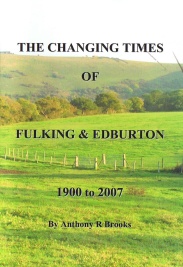
I would like to update all those who sponsored or purchased my book [Anthony R. Brooks (2008) The Changing Times of Fulking & Edburton. Chichester: RPM Print & Design] how the proceeds of £3,800 have been spent by the Church.
Originally it was earmarked for a new door to be added to the church entrance. After much thought the PCC decided that as the Church is used during the winter months twice a month for a maximum of two hours, money spent on a new door would not be cost effective. So a compromise was agreed:
A warm air unit would be fitted over the church door inside.
The entrance path to the church has been reshaped to include a patio to give more standing area.
I am pleased to say both projects are now complete.
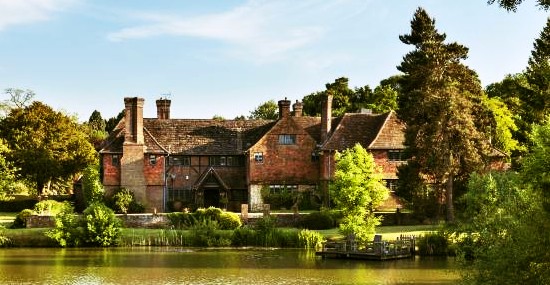
Set in 149 acres of lakeside gardens and grounds, pasture, deer park and woodland, the house, first mentioned in records of 1339 and 1434, has evolved over time around the core of a late-medieval stone building, of which only one storey survives, with an early-17th-century, timber-framed first floor above it.
According to its listing, the south parlour was rebuilt in the early 1700s as part of a new five-bay range running eastwards, and the entire house was refaced in about 1920, and extended to the east, west and north, in the revived Sussex Vernacular style, par timber-framed and part tile-hung. The park, restocked with deer by the current owners, who bought Woodmancote Place in 2002, was established in the late 19th century; the gardens around the house were laid out by Cheals of Crawley in 1923. As the chief manor house of the village, Woodmancote Place has had its share of famous-and infamous-owners.
In 1530, Woodmancote passed to Catherine, wife of Sir Edward Seymour, later Earl of Hertford and 1st Duke of Somerset, who was executed for treason in 1552. In 1531, Seymour sold the manor to Richard Bellingham, whose widow married George Goring, described as lord of the manor in 1560. For 200 years from 1693, the estate was owned by the industrious Dennett family, who extended the house and increased the farmland to 402 acres by 1840.
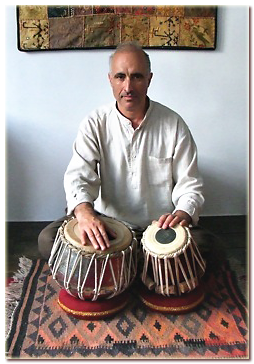
Steve Morley invites all those interested in learning classical tabla drumming or being part of a regular percussion and music-making group for Fulking and Poynings, to come along for an informal get-together in Fulking Village Hall at 2:30pm on Sunday 15th September. You’ll be able to try some basic tabla, World percussion instruments and effects. No experience whatsoever is required.
Steve first studied tabla with Pt. Chotelal Misra in Varanasi, India in the 1980s, and was also under the tutelage of the late Pt. Sharda Sahai of the Benares tradition. He has been teaching classical tabla and working in education for 20 years.
[A] condition imposed with planning permission requiring existing tiles to be reused was lifted. New tiles have instead been used to reroof the historic building .. Town councillor Colin Hughes hit out as members of the planning committee debated an application from the national park to ‘discharge’ another planning condition governing external insulation and lime render for the 1930s wing of the building. “I am concerned that the new tiles make Capron House look like a new housing development and I wonder what has happened to the original tiles. I don’t believe the South Downs National Park should be judge and jury over its own planning application – the plans they set themselves to achieve originally. I find it difficult that the national park can discharge obligations that it set itself in its original plans – obligations which presumably they felt desirable for this type of building in the first place. They lose credibility in terms of applications which come before them from developers in the future. It seems there is one law for them and one for everyone else.” .. The application to discharge condition seven governing the insulation and render was the fourth similar application to go before town councillors.
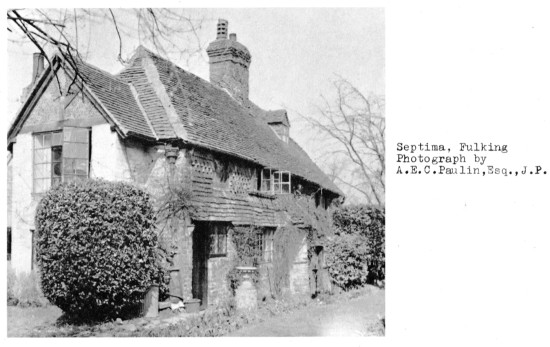
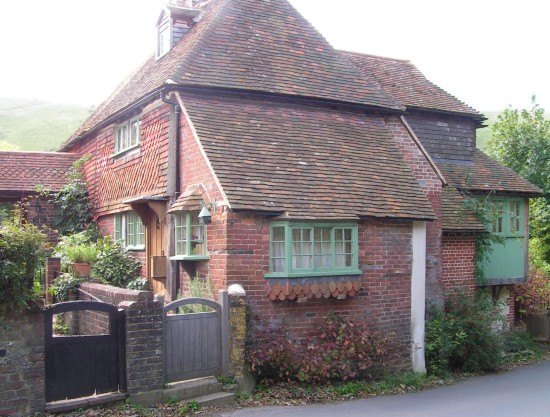
Septima Cottages is a Grade II listed building on the corner of The Street in Fulking as it turns south down to the Shepherd and Dog. During its long history it has, at times, comprised one dwelling or two (as it is now). The listing details are terse, as usual:
C17 or earlier timber-framed building refaced with red brick on ground floor and tile-hung above. Tiled roof. Horizontally-sliding sash windows. Two storeys. Three windows.
Howe (1958, page 32) refers to “an outshut wall built in masonry which may be mediaeval” and provides a much more informative description written by Albert Paulin who was living in Septima during the 1950s:
Date uncertain but said to have been in existence in 1643: first recorded date 1812 (Conveyance: purchase from H.M. Commissioners of Woods and Forests at price of about £60): Original brick floors on ground floor, apparently laid on some such base as puddled clay. They are very dry. Upper floors, original wide board, approximately 18 inches wide: appear to be mixture of oak and chesnut. Roofing tiles mainly original, pegged to oak battens with oak pegs. Two windows have original leaded lights with flint glass. Bread baking ovens well preserved. One original staircase still in use. Much of the brickwork up to first floor level appears to be original. Inside partitions plaster and lath between original oak vertical puncheons. Roof carried by heavy oak tie-beams, curved to give headroom over door openings, but even so, a bare five feet headroom. [Howe 1958, pages 36-37.]
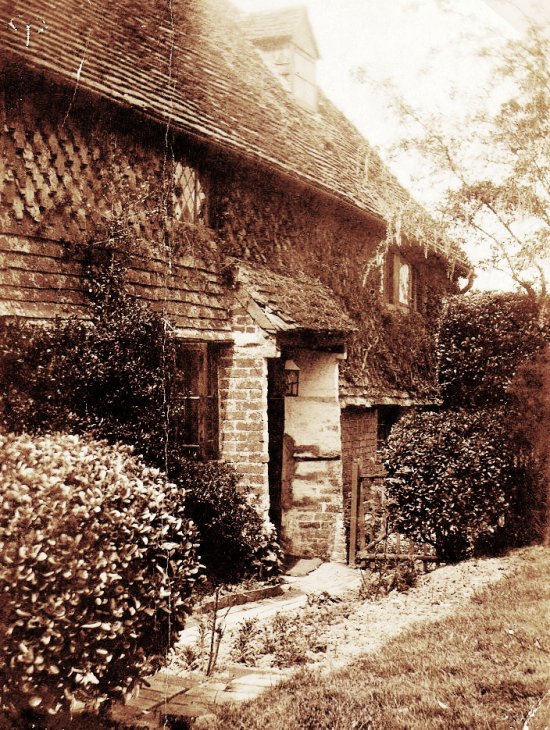
The building was sold as two tenanted cottages in 1914. The auction particulars showed Number 1 as having two bedrooms, a living room with an oak timbered ceiling and chimney corner fireplace, a washroom with a copper and a pantry. Number 2 was described as a creeper-clad cottage with one bedroom, a living room with an oak timbered ceiling and open fireplace, a small sitting room, a washhouse and a privy shared by the two cottages (the creeper was still thriving in 1999). Primrose Cottage, which is next door, was sold at the same auction and there was a covenant to ensure that the occupants of Septima would have continued access to its well. The Septima cottages were let at the time of the auction for between two and three shillings a week each, around 10% of the then current wage for an agricultural worker.
The building owes its name to Ann Septima Cuttress who was born around 1839 and who lived in the cottage for most of a long life. The name probably originated as the simple description “Septima’s cottage”. Ann’s father James had been born in Fulking in 1797. In 1841 he was working as a market gardener and living with his wife Mary and eight daughters in what the census calls ‘Lower Paythorn’. Mary died in 1846. After his wife died, James moved to Septima. In 1851, he was living there with his two youngest daughters, Ann and Barbara. He was still working as a market gardener. In 1858, Ann married Benjamin Baldey, a farm worker originally from Falmer, and he moved into the cottage. Ann was a minor (under 21) at the time of her wedding and thus required her father’s permission to marry. Benjamin was ten years her senior. The 1861 census shows them with two daughters and with James, now in his sixties and working as a shepherd, living with them as a lodger. He was still there in 1871, retired from shepherding but surrounded by half a dozen grandchildren. He died a couple of years later at the age of 76. Ann was to have a total of fifteen children, at least three of whom died in infancy. One of her sons, Charles, became the publican at the Shepherd and Dog and one of her grandsons, also called Charles, is commemorated on the 1914-1918 war memorial in Edburton churchyard.
In 1914, Ann and Benjamin were living in Number 2 and their son Percy was living in Number 1 with Nanny, his wife, and their children. Although they were tenants, the building had remained in the ownership of the Cuttress family until the auction in that year. Benjamin Baldey died in 1915 at the age of 87. Ann remained in residence and, when the war ended, she converted the small dining room of Number 2 into the village sweet shop. The entrance was via a stable door situated where the oriel (bay) window is now located. Ann also served teas in the garden and took in lodgers, some of whom were artists. She died in 1925 at the age of 86 — she had lived in Septima for nearly eighty years.
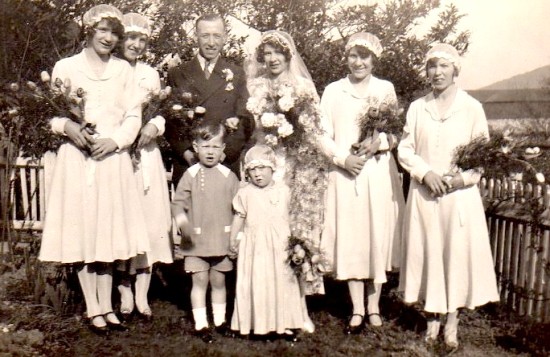
In the 1920s, a Mr and Mrs Purdew were photographed outside their new home, Number 1, on their wedding day. Mr Purdew was probably a descendant of the Purden/Purdew family that lived adjacent to the Baldey family in the 1870s. However, the Purdews had moved to Perching Sands by the 1880s.
In the 1940s, two sisters, Charlotte (‘Lottie’) and Marjorie Clark, lived in Number 1 and they went on to purchase Number 2. In her youth, Lottie had been a milliner and sometimes modelled fur coats complete with one of her hats for a London fashion house. During this time she was required to live in a staff dormitory, supervised by a matron who carried out daily inspections to ensure that all the girls looked their best and that no unauthorised changes were made to their appearance. Marjorie was musical and played the organ for the church and the piano for village concerts. She went on to marry Albert Paulin, a magistrate and an important figure in 1950s village life. They lived in Number 1 and Lottie moved into Number 2 where she lived until her death in 1976, aged 96. In due course, Albert and Marjorie Paulin moved to Thatchly, a distinctive 1930s house that is at the other end of The Street from Septima. Marjorie died in 1972, aged 76. A photograph of Septima Cottages taken by Albert Paulin in the 1950s and printed on page 96 of F.A. Howe’s 1958 book on Fulking.In the 1980s, Emile Curtis bought both cottages and set about supervising their renovation. Part of the garden of the Old Bakehouse had been purchased in 1981 and used to increase the size of Number 2’s garden. All the work undertaken on the cottages had to meet the strict criteria required for altering a listed building: the roof tiles were removed and refitted with new oak pegs and a damp-proof course was added by injecting a silicon solution into the solid exterior walls. The timbers were treated throughout with wood preservative, the cottage was completely rewired, new drains were constructed and the plumbing was replaced and updated. A hot water system and night storage heaters were installed. Finally, insulation boards were fitted to an extension and the front elevation and finished with hanging tiles. While work was in progress Emile discovered an interesting feature: back-to-back cupboards had been built between the two cottages that gave access to the next-door cottage. Further extension and refurbishment took place in 2005.
Septima Cottages in 2007
Tony Brooks
Reference
F.A. Howe (1958) A Chronicle of Edburton and Fulking in the County of Sussex. Crawley: Hubners Ltd.
The Department of Transport is giving the SDNPA more than £5 million to create a network of cycle routes into and around the South Downs National Park, including improvements to routes in Hampshire, extensions to routes in West Sussex, and the creation of new routes out of Brighton and around East Sussex. Routes that incorporate railway stations will get particular attention. Implementation is intended to take two years. Further details are due soon.