The Dyke Railway 1887-1938

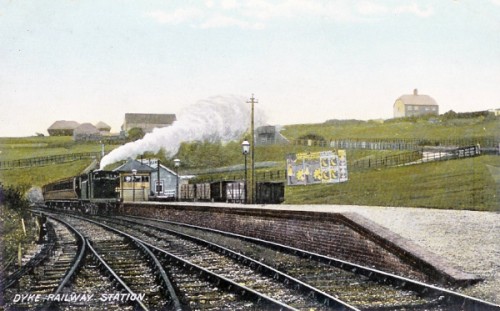
Dyke Railway Station around 1905
Dyke Station viewed from the south around 1905. Note the goods wagons to the right of the platform and the fenced lane leading up the hill. The farmhouse at top right was destroyed during WWII.
Plans for a railway to link Brighton to the Dyke were first mooted in the early 1870s but did not receive parliamentary approval until 1877. It took another decade before the railway was finally opened. In addition to the usual legal and property issues that attend the creation of a railway line, the overall gradient of 1 in 40 posed a significant technical challenge as did the hard chalk rock found at the end of the route. Indeed, the terminus of the line fell short of the Dyke by several hundred yards because the gradient at that point made further extension impractical.

Over the first year of operation, some 160,000 passengers were carried. The only intermediate stop at that time was at West Brighton (now Hove) Station. The total distance was 5.5 miles of which 3.5 were on the slope of the Downs. The trip took twenty minutes (just as the 77 bus from Brighton Station does today). The first additional intermediate stop to be added to the line was Golf Club Halt in 1891. This was a private platform built on what was then the property of Brighton & Hove Golf Club and provided for the use of its members. Two further intermediate stops opened in 1905, both on the main Brighton-Portsmouth line: Dyke Junction Halt (later renamed Aldrington Halt) and Holland Road Halt. The fourth, and final, addition was Rowan Halt built in 1933 to serve the new Aldrington Manor Estate that was then being developed to the north of the Old Shoreham Road.

The railway remained in operation for half a century with the exception of a closure of three and a half years at the end of WWI. When the line first opened in September 1887, there were eight trains a day (five on Sundays) between Brighton and the Dyke (and conversely). In June 1912, there were eleven trains a day (one fewer on Sundays). In November 1938, the penultimate month of operation, there were sixteen trains a day (half as many on Sundays). Conventional locomotives were used for most of the line’s life although a prototype steam railbus (essentially a large bus mounted on two bogies) was employed on the line in the mid-1930s and proved to be very popular with customers.
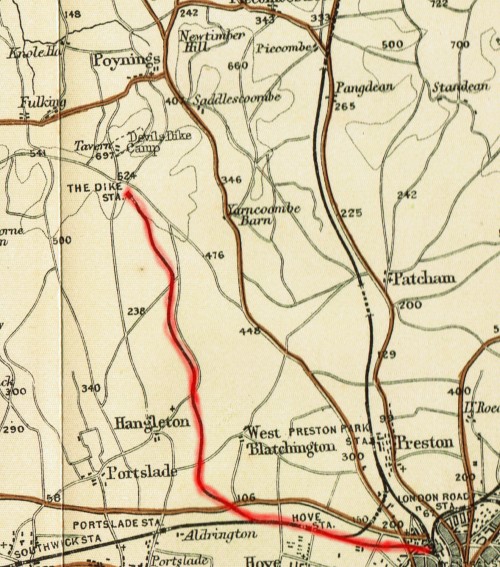
Dyke Railway map from the 1890s.
An 1890s map showing the route of the Dyke Railway
Although useful to members of the various golf clubs situated between Brighton and the Dyke, the primary passenger function of the railway was to take day trippers up to the Dyke in the morning and bring them back in the evening. Demand was thus seasonal and weather-dependent. Many of these visitors would use the Dyke as the basis for a day’s walking. Teashops sprang up in the villages at the foot of the Dyke to cater for their needs. Fulking and Saddlescombe each had one and Poynings had four at one stage. For those unwilling to stray off the Dyke itself, refreshments were also to be had at the Dyke Hotel and at Dennett’s Corner which was only a few yards from the station. A secondary passenger function was to take residents of Edburton, Fulking, Poynings, Saddlescombe and the various local farms into Brighton. The roads were poor and buses did not reach the Dyke until the 1930s. If you were not wealthy enough to have the use of a horse or, later, a car, then access to Brighton was difficult before the railway was built. Locals used the service to shop in Brighton and others commuted to work there.

Passengers were the main focus of the railway. But it also offered a goods service and this was economically important to the local villages. A goods siding was built at the Dyke Station in 1892. Coal, coke, cattle fodder and parcels were transported to the Dyke and collected from the station by horse and cart or by the local coal merchant. The latter then delivered both coal and parcels in the villages (and was paid a penny for each parcel by the railway company). On the return journey, goods wagons would take straw, hay, grain and local produce from the farms and market gardens into Brighton. Goods traffic was discontinued in January 1933.
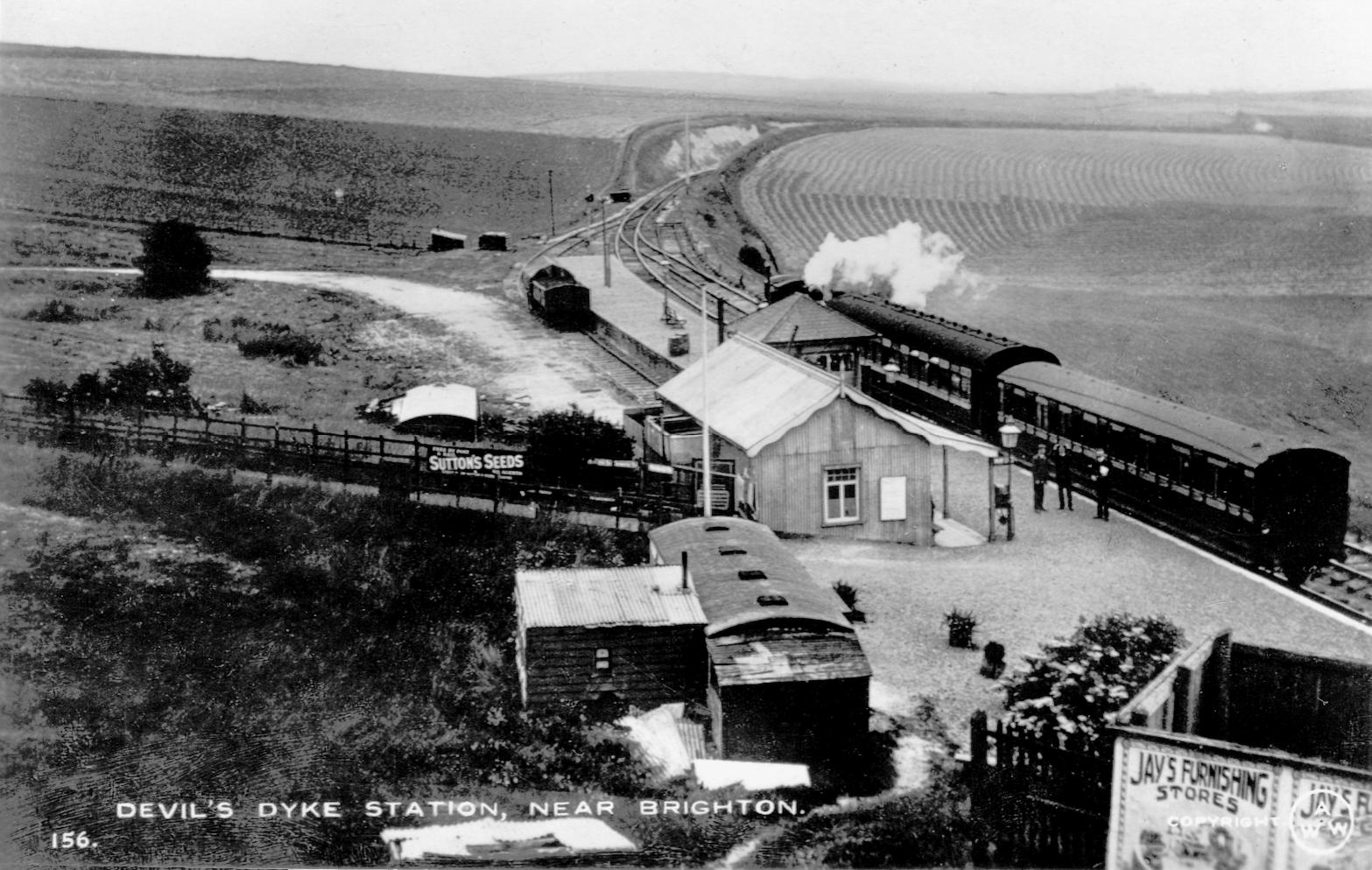
Dyke Station viewed from the north around 1911
Dyke Station viewed from the north around 1911. Note the signal box, the goods siding to the left of the platform, and the fenced lane, complete with ‘Suttons Seeds’ billboard, leading from the station to the roads to the Dyke Hotel and to Saddlescombe. The old carriage, with attached sheds, in the foreground was used as a refreshment room. In a very similar contemporary photo, a horse and wagon can be seen drawn up besides goods trucks in the siding (Harding 2000, page 10).
Golf Club Halt was a request stop rather than a real station. It never appeared in the rail timetables. However, the wishes of club members were reflected in the details of those timetables. There was a platform but that was all. You couldn’t buy a ticket for it — you had to purchase a ticket for the Dyke Station. If there were golfers on board, then the train would stop there to let them off. On the return journey, the train would stop to pick up golfers if they were visible on the platform (after dark, they struck matches). The platform was (and is) some fifty yards north of the clubhouse, perhaps because the gradient adjacent to the clubhouse made a more convenient location infeasible. However, from 1895 on, when a train was about to leave the Dyke Station, a bell would ring in the clubhouse alerting departing members to the need to make their way to the platform immediately. Although club members had mostly taken to using motor cars in the 1930s, the halt remained in use (especially when the weather was poor) until the railway itself was closed.

Golf Club Halt 2012
Golf Club Halt — the edge of the platform in 2012
What remains of the railway today? South of the bypass, Brighton’s urban sprawl has eradicated almost every trace of it. Aldrington Halt remains in use, albeit unmanned. North of the bypass, the route is still visible either from the sky or on the ground, but you need to know what to look for. The cuttings and embankments that were needed to make the uphill route possible are there and dense scrub marks the location of the track for several long stretches. A public cycleway (the Dyke Railway Trail) running parallel to, or along, the track extends from the bypass to Brighton & Hove Golf Club. From then on, the line of the track runs through private farmland but a strip of scrub reveals its presence. Much of Golf Club Halt, which was never more than a platform, is still there, hidden in the scrub. At the northern terminus, Devil’s Dyke Farm now stands where Dyke Station once was. All that was left of the station a dozen years ago was a small chunk of the platform.

Further reading:

  • Paul Clark (1976) The Railways of Devil’s Dyke, Sheffield: Turntable Publications. [This booklet contains a detailed history of all aspects of the line and includes maps, photos, transcripts of relevant documents, and engineering diagrams.]

  • Peter A. Harding (2000) The Dyke Branch Line, Byfleet: Binfield Print & Design. [Reprinted in 2011, this well illustrated booklet is currently the most readily available work on the history of the railway.]

  • Hove Borough Council (1989) Dyke Railway Trail [PDF], a four page leaflet. [The map contains a number of errors: e.g., both the exact railway route and Golf Club Halt are mislocated. Nevertheless, the leaflet is still useful if you plan a walk in the area.]

  • Barry Hughes (2000) Brighton & Hove Golf Club: A History to the Year 2000. Brighton: B&HGC. [Pages 27, 30, 33, 42, 48, 60-61, and 115 contain material relevant to the railway and Golf Club Halt.]

GJMG

Some other material relevant to the C19 and C20 history of the Dyke:
Castle Ring

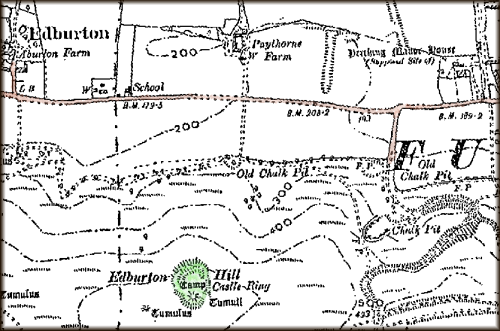
The location of Castle Ring
A nineteenth century Ordnance Survey map showing the location of Castle Ring in relation to Edburton Road which sits some 400 feet below it.
Castle Ring[s], also known as Edburton Castle or Edburton Camp, sits at the peak of Edburton Hill on the Downs halfway between Fulking and Edburton. It cannot be seen from the road. It can just be seen from the South Downs Way as you descend the western slope of Perching Hill, but only if you already know what you are looking for. There is no marked footpath to it. Getting there entails a steep climb across a field. But it is worth the effort. The structure itself, which has ‘scheduled monument’ status, is impressive and the views over the Weald are the equal of those from the Dyke.

Castle Ring has not been excavated and rather little is known about it or what it was for. Even the date of construction is uncertain although most sources point to the end of the 11th century, immediately after the Norman conquest. Volume 1 of the Victoria County History, published in 1905, refers to it as “this curious little work” and remarks that:

There no traces of masonry, and, as far as one can see, there is no supply of water near. Why it should be placed here is a mystery, unless, indeed it was a signalling station visible perhaps from Pulborough and Knepp Castle.
[Page 1905, page 476]

Volume 7, published in 1940, is likewise terse:

It has a very small rectangular bailey [= external wall], and an equally insignificant motte [= mound]. It is probably an outpost castle constructed soon after the landing in 1066. The boundary of the rape [= administrative district], and the division between East and West Sussex, passes immediately to the west of the motte ditch.
[Salzmann 1940, page 202]

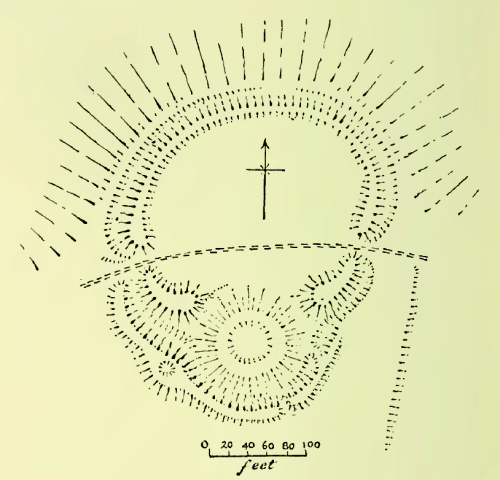
Plan of Castle Ring
Plan of Castle Ring taken from Allcroft 1908, page 660
Hadrian Allcroft’s magisterial Earthwork of England, published in 1908, still provides the most comprehensive archaeological description and discussion of the site:

Edburton Camp crowns a prominent hill-bastion of the northern face of the Downs .. In position it resembles Chanctonbury, as also in having one vallum [= earth rampart] and one fosse [= trench or moat], but it is singularly small even for a Sussex fortress, measuring no more than 60 yards across the widest diameter of the diminutive area, and in plan is quite unlike any other hill-top fortress. The line of the defences follows the oval contour of the exiguous hill-top on all except the southern side, where it is interrupted by a depressed mound of 100 feet in diameter, the fosse looping outwards to cover the base of the mound. The whole plan, therefore, is at first sight much that of the simplest form of mount-and-bailey fortress. But on close examination this resemblance will be found to be less real than apparent: the mound is too low to have been a motte, for it does not attain even to the 10 feet or so of vertical height reached by the vallum on either side of it, and it can never have been much higher than it now is, for had it been greatly wasted the fosse along its southern side must have been far less deep than now, and the depression at its centre must have disappeared. More important still, the fosse is not carried round the northern side of the mound, and apparently never was. The vallum to east and west rises to more than average height, but ends abruptly, neither reaching to the mound nor being continued round its base. A shepherd’s path traverses the area, passing the vallum by openings seemingly both original in the eastern and western sides. From the western entrance commences a second vallum, which follows the edge of the fosse right round the southern angle of the camp and then gradually disappears. It is at its highest in the angle where the fosse bends to accommodate the mound, and at this point is a circular depression about 8 feet wide in its broad summit. The great mound is neither flat-topped nor ringed by a vallum, but in its centre has a cup-shaped basin 33 feet in diameter and perhaps 3 feet deep. The ground to the south of the camp is to all intents level, but there are no signs of any outworks, unless a small and low mound 80 yards to the south-west be such. From the eastern entrance, where the slope is steeper, a very slight scarp is traceable for some 40 yards in a direction west of south. It is perhaps an old plough-mark. Fragments of pottery are to be found in the mole-casts along it. Further to the west lie several barrows which have yielded very early remains.

Of all the South Down camps this is the most puzzling: it would indeed be difficult to find another like it anywhere. It has been said of it that it “has nothing in common with the hill-forts (of Sussex).” One would rather say that it has everything in common with them except the mound. The nearest analogy to the mysterious mound with its depression is that within the area of Mt. Caburn, which would seem to have been a reservoir. It is much to be regretted that Pitt-Rivers, who explored the one, did not examine the other also; and small as Edburton Camp is, the task of exploring it completely would be an easy one. Meanwhile there is nothing but conjecture. Some have suggested that the mound was a beacon. If that were so, what was the need of the rest of the earthworks? Yet they are all apparently of one plan with the mound and of one date. Others believe it to be a Norman fortress; but against this is the absence of any encircling fosse about the whole of the mound, quite apart from the exceptional character of the site, at an elevation such that no water can have been found within several hundreds of feet at any time during many centuries past. Edburton must remain a mystery until the spade is brought to unlock its secret.
[Allcroft 1908, pages 659-662, footnotes omitted]

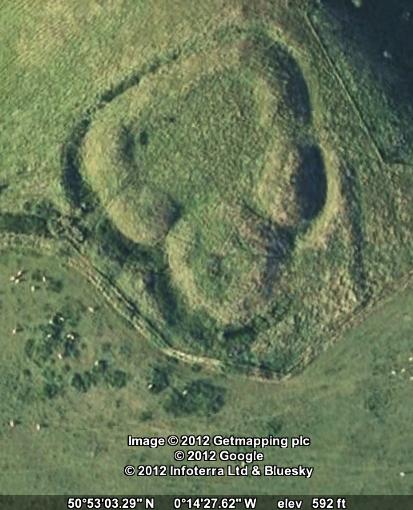
Google Earth image of Castle Ring
Aerial photograph of Castle Ring from Google Earth
Recent reference material (i) lists the structure as “Early Medieval/Dark Age — 410 AD to 1065 AD” but then immediately goes on to say that it is believed to be Norman; (ii) claims that the central depression resulted from “mistaken barrow digging in the 19th century” but offers no evidence for this speculation; and (iii) suggests that the use of Castle Ring was “more likely to have been administrative and residential” than military but fails to address the implications of the apparent absence of any water supply. It seems that Allcroft’s conclusion — “Edburton must remain a mystery until the spade is brought to unlock its secret” — is as true today as it was more than a century ago.

References and further reading:

GJMG

Currently popular local history posts:

Nathaniel Paine Blaker

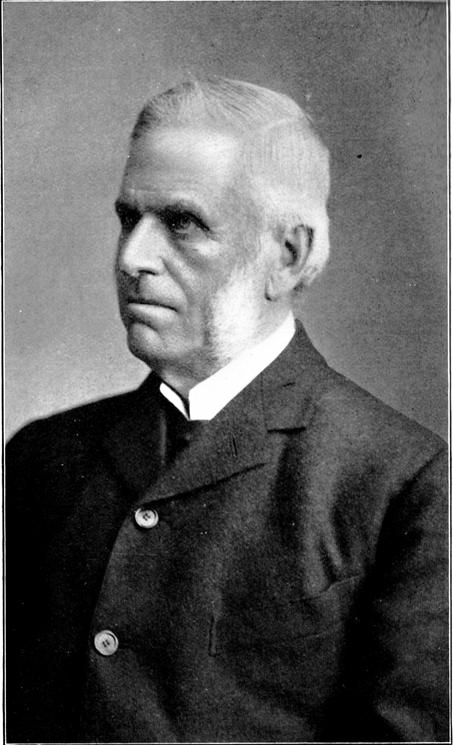
Nathaniel Paine Blaker 1835-1920
Portrait of Nathaniel Paine Blaker (1835-1920) by A.H. Fry

The Blakers are a Sussex family with a long pedigree. They have been around since at least the end of the thirteenth century and their Portslade branch dates back to the end of the fifteenth century. Although he was born in Selmeston, Nathaniel Paine Blaker (1835-1920) [NPB, henceforth] descended from the Portslade Blakers. NPB’s great grandfather, Nathaniel Blaker, who died in 1815, was “a very prominent citizen of Portslade in the 18th century” according to The History of Portslade: An Interim Report. One of his seven sons, also called Nathaniel Blaker (1772-1863), moved to Selmeston. And he in turn had a son, also called Nathaniel Blaker (1800-1880), a farmer who moved to Perching Manor in Fulking with his wife and son in 1835, shortly after the birth of NPB, who was to remain an only child. It was clearly a prosperous family — the 1841 census records a total of five household servants, more than any other household in the parish of Edburton at that time.

NPB trained as a surgeon. Although his father was a farmer, and probably his grandfather too, such a choice of career was in no way surprising for a Blaker — two cousins and a great uncle also became surgeons. NPB started at Sussex County in 1852 and then went on to Guy’s in 1855, qualifying in 1858. He practiced at convict hospitals in Lewes and Woking before returning to work in Brighton, initially as House Surgeon at the Brighton & Hove Dispensary in 1860 and then in the same role at Sussex County in 1864 with promotion to Assistant Surgeon in 1869, later becoming a Senior Surgeon and subsequently Consulting Surgeon there.

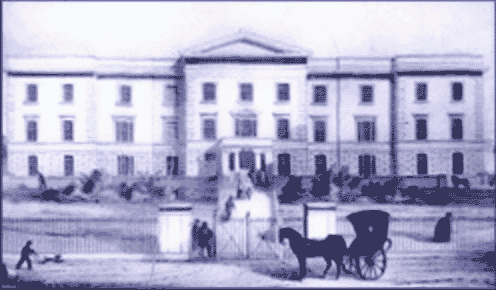
Sussex County Hospital as it was in the mid nineteenth century
Sussex County Hospital in the mid nineteenth century

At some point when NPB was in his 60s, a medical friend suggested that NPB commit his reminiscences to paper. He was, presumably, expecting a record that would concentrate on NPB’s long medical career. But that is not what he got. In 1906, NPB wrote to his friend as follows:

Though medical matters are, of course, what you are most interested in, I trust you will pardon my endeavour to give a sketch of a Sussex village as in childhood I recollect it, before railways, better roads and easier means of communication had done away with the primitive habits and customs of the rural population as I first knew them.
[Letter to Dr. Arthur Newsholme, 30th July 1906]

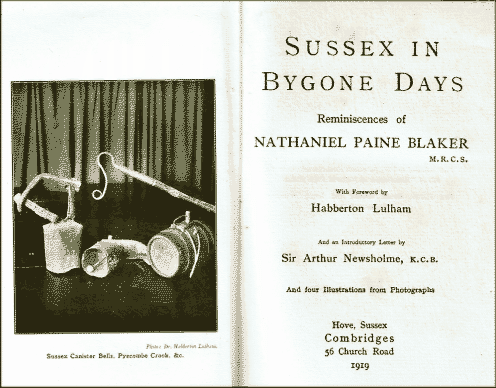
Sussex in Bygone Days: title and facing pages
Sussex in Bygone Days: title and facing page

In the event, NPB’s informative and affectionate portrait of rural Sussex as seen through the eyes of a child and teenager occupies the first 138 pages of the book that he wrote. The long medical career gets a mere 60 pages and he tells us virtually nothing of his life from 1870 onwards. But he got the balance right. Miles of shelves in Hay-on-Wye groan and splinter under the weight of dusty Victorian medical reminiscences that few buy and fewer read. By contrast, various editions of Sussex in Bygone Days, including modern paperback copies, are readily available on Amazon and elsewhere. The original version of the book was printed, “for private circulation only”, in 1906. The version that is most readily available today is the “revised, extended and largely rewritten” book that NPB published in December 1919, the year before his death. In addition to A.H. Fry‘s superb photographic portrait of NPB, the 1919 book contains three historically interesting photographs taken by Dr. Habberton Lulham who also wrote the foreword (one of those photos can be seen facing the title page, above). Sussex in Bygone Days fully deserves its status as a classic of Victorian rural history alongside Maude Robinson’s book about Saddlescombe. NPB’s friend and colleague Sir Arthur Newsholme got his prediction exactly right:

I cannot but think that our successors fifty or a hundred years hence will be glad to read such a vivid account of the rural life of a favoured part of our Old England, as it was lived in bygone days. It is a fragment of local history which has permanent value. [Letter to NPB, 21st May 1918]

Further reading:

GJMG

Currently popular local history posts:

Kent Cottage

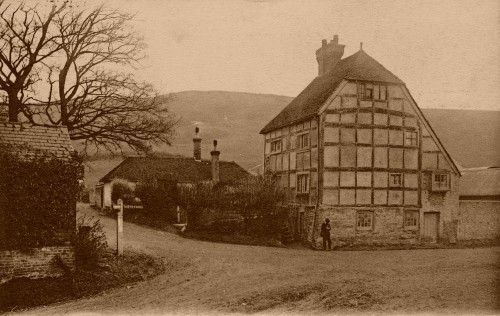
Kent Cottage in the 1900s
An unsigned article in St. Andrews Quarterly for April 1950 is devoted to Kent House, as the building was then known:

A particularly fine specimen of half timbered architecture stands prominently at the entrance to the Village High Street of Fulking. Although some of the older inhabitants of the village recall its name as Kent Cottages, for there were originally two cottages but now joined into one, there seems to be no record of the change in the construction or its name.

The main part of the building dates from 1600 and one can easily detect the old portion as distinct from the more modern side — the lofty structure is raised over a basement, above which are two floors and is constructed entirely of timber framing in large braced panels.

Through the ages several interior alterations have been made, none of which have added to its original charm, although they have not destroyed the original structure.

Over the cellar remain the ‘Parlour’ with its outshut and large open fire-place with cambered and stop chamfered chimney beam, and a half bay on the other side of the chimney stack: in the sides of the chimney shaft still remain the large wrought iron hooks from which the huge joints of pork were hung to ‘smoke’. The beams on the first floor are all stop chamfered.

Little is known of this delightful old building and it would prove interesting reading if its history could be compiled: many of the inhabitants of Fulking have in fact lived in this house at one time or another and can recall earlier days when it was used as the Village Infirmary.

The building is far from being in good state of repair and we can only hope that it is not allowed to fall into decay

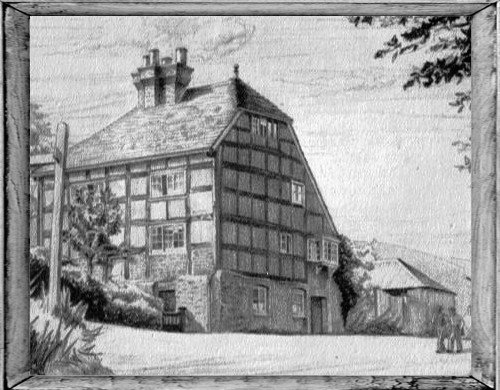
A drawing of Kent Cottage, date unknown
A drawing of Kent Cottage by W. Bothwell, date unknown
Writing a few years later, F.A. Howe adds some details about the construction of the building and confirms other aspects of the 1950 account:

In a commanding position at the entrance to the village from the east, on the south side, is Kent House, of about the year 1600. It is a lofty and imposing timber-framed building in large braced panels and consists of two storeys and an attic. The slope of the site is dealt with by the addition on the north side of a kind of undercroft. The south side of this chamber is a wall of the solid chalk along which rests an immense beam on which rests the interior timber framing of the floors above. Formerly it was known as Kent Cottages and was at that time two dwellings. Inhabitants now living say that their parents remember its being used as a poor law infirmary. [Howe 1958, page 32]

At some point during the last fifty years, the name of this Grade II listed building reverted to Kent Cottage, despite it being the tallest and one of the most striking houses in the village. It was once part of a two bay house and what we see today are the remaining one and a half bays of the original house. In the late 1800s and early 1900s, following the introduction of the Poor Law Amendment Act in 1834, it was used as a workhouse as well as an infirmary.

Many original features have been retained throughout the various changes documented above, including exposed beams and large open fireplaces in most rooms, even those in the attic. Consequently, a large chimney, some nine foot square, runs through the centre of the house to serve all these fireplaces. Along with this, a series of very steep, narrow staircases lead to the attic passing through the rooms on the upper floors, which greatly reduces the room sizes and gives the interior a quaint and unusual atmosphere. Over the years the external façade and historic character of the building has remained largely unchanged, apart from the addition of a conservatory tucked away on the south side of the building, which was added in 2003 and complements the interior of the house.

Kent Cottage in 2007
Tony Brooks

References

  • Unknown author (1950) “Kent House”, St. Andrews Quarterly 6, pages 13-14.
  • F.A. Howe (1958) A Chronicle of Edburton and Fulking in the County of Sussex. Crawley: Hubners Ltd.

[Copyright © 2012, Anthony R. Brooks. Adapted from Anthony R. Brooks (2008) The Changing Times of Fulking & Edburton. Chichester: RPM Print & Design, pages 161-162.]

Currently popular local history posts:

The Ladies’ Golf Course

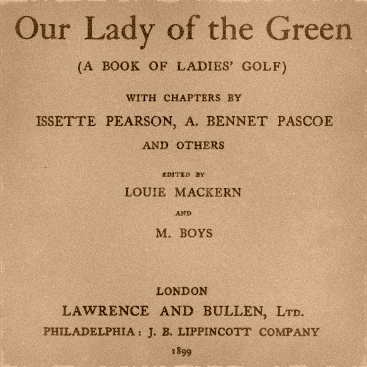
Our Lady of the Green 1899

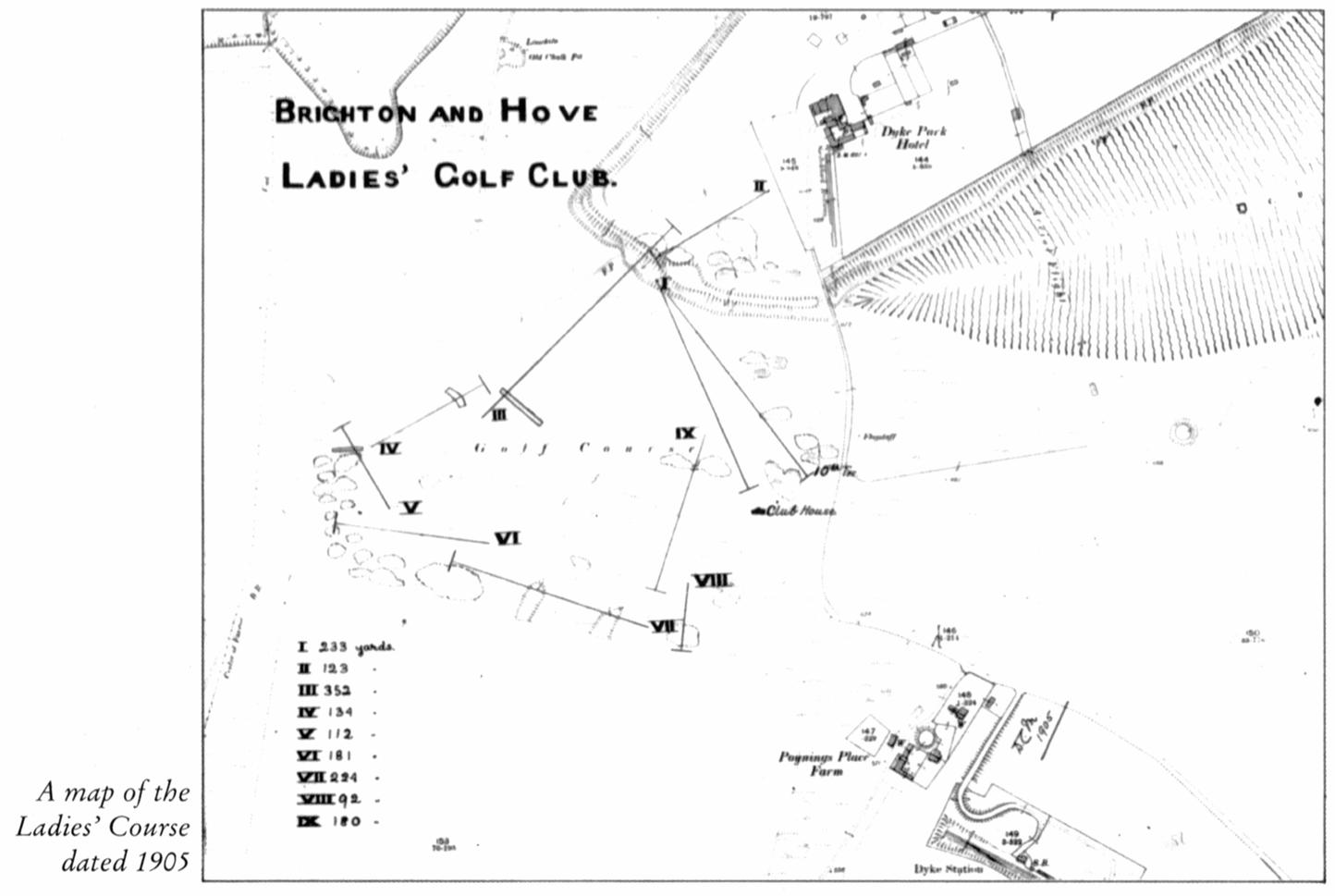
As you drive up the Devil’s Dyke Road, north of the bypass, you reach a point where you are less than half a mile from four different golf courses. That’s a lot. By contrast, the whole thirty mile stretch of Downs between Shoreham and Hampshire contains exactly as many, “two at Goodwood and two north of Worthing” (Bangs, page 159). For nearly fifty years, if you had followed the road a bit further, to the very top of the Downs, you would have come to yet another golf course. This one was immediately adjacent to, and to the south-west of, the Dyke Park Hotel. The associated club was an offshoot of the Brighton & Hove Golf Club [B&HGC] and membership was exclusively female: the Brighton & Hove Ladies’ Golf Club.

Ladies Golf Course 1905
A 1905 map of the Ladies Golf Course (from Hughes, page 62)

The course existed from 1891 to 1939. It was served by the Dyke Station, located to the south-east just off the map image shown above, over almost the entire period. It was thus very conveniently situated for members who lived in Brighton or Hove although it seems that most arrived “by pony and trap or by bicycle, or later on, by motor car” (Hughes, page 64). It had its own clubhouse and catering would also have been readily available at the Dyke Park Hotel.

As a consequence of WWI, the course closed for the period 1916-20 but members used the grounds and the clubhouse to entertain wounded soldiers. Play resumed in 1920 and the club began to attract younger players. The outbreak of WWII saw the final end of both club and course. The railway closed in December 1938 and the Ministry of Defence requisitioned much of the Downs. The clubhouse was completely demolished, possibly by Canadian tank crews. After the war, former members of the club had to fall back on their status as associate members of B&HGC if they wanted to play.

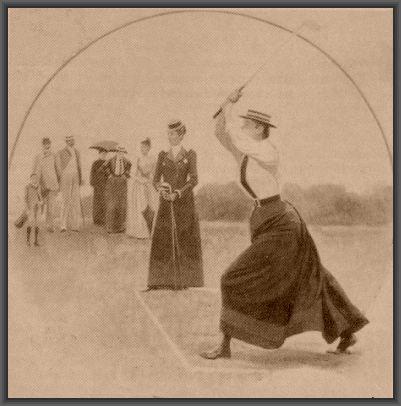
Miss Starkie-Bence 1892
Miss Starkie-Bence drives an ace to the North Town Field.

Well, probably not. But Miss A.M Starkie-Bence used to play on the course and she was a distinguished Sussex golfer active in the final decade of the nineteeth century, one who held numerous course records and medals. [The image derives from an 1892 issue of The Gentlewoman.]

Further reading:

  • Dave Bangs (2008) A Freedom to Roam Guide to the Brighton Downs. Portsmouth: Bishop Printers.
    [Pages 158-162 contain a rather comprehensive discussion of the many golf courses that have existed on the fringes of Brighton over the years.]

  • Barry Hughes (2000) Brighton & Hove Golf Club: A History to the Year 2000. Brighton: B&HGC.
    [Chapter 4, pages 62-67, contains the definitive history of the Ladies’ Golf Club.]

GJMG

With thanks to B&HGC for their assistance and for granting permission for the use of the map.

Amended 30th January, 2013.

Some other material relevant to the C19 and C20 history of the Dyke: