[This post consists of two items that partly document the life of Albert E. Browne whose home was in Fulking, or the immediately surrounding area, for fifty six years.]
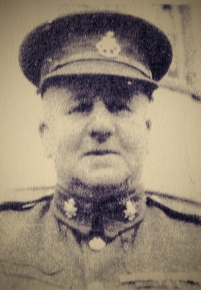
Fulking is .. proud of its son who has been awarded the O.B.E., and that I gathered when I saw the smiling countenance of a sergeant-major gazing at me from a frame. Now this is a rarity, for who has heard of a smiling sergeant-major, they are usually the reverse, so I stepped over to see who it was. I found it was none other than Mr. A.E. Brown. Yes, it is Mr. Brown now that he is back in civvy street.
Beneath his picture was the inscription, “Yes sir. Fulking is very proud of its O.B.E.” I stepped out to find him, and was fortunate to catch him before he started out on his lawful occasion, for he is busy these days.
I think he must be the most travelled son of Fulking, for it was in 1906 that he joined the 1st Battalion of the Royal Sussex Regiment and went off to India, where he spent 13 years. When his time with the regiment expired he endeavoured to “soldier” on, but the authorities turned him down so he returned to Fulking. With the outbreak of the last war however, he was soon in the thick of it, and with various establishments travelled everywhere, in fact he seemed to be always on the move.
Now that he has settled down in the quiet of a Sussex village, still with his smile but the Browns are still serving their country, for all three sons are serving with the forces, and strange to say in the three different services. One has recently brought home to Fulking his French bride, who is settling in, and enjoying her stay in this remote district.
[R.J.S., Rambling Reporter at Fulking, Southern Weekly News, 12th July 1947]
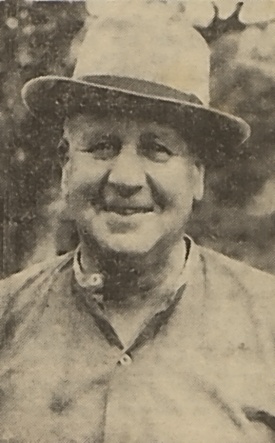
It is with very deep regret that we record the passing away of Mr. Albert E. Browne, O.B.E., on Tuesday October 10th, 1950 in the Elm Grove Hospital, following a very serious illness and operation: the Cremation took place at the Brighton Crematorium on Saturday October 14th, 1950, there being many beautiful floral tributes.
He and his family have been associated with the village for a very long while, in fact ‘Albert’ first came to Fulking in 1894 and for the past 17 years has resided in Yew Cottage. Perhaps, to many of us, he will be better remembered in Uniform for he spent no less than 30 years in the Service of H.M. the King, doing duty in many parts of the world, indeed the honour of ‘O.B.E.’ bestowed on him just before being pensioned, was well deserved.
After his retirement from the Service he was pleased to work for many in the Village and readily stepped into the breach to fill the gap upon the retirement of Mr. Walter Page as Clerk to Fulking Parish Council, holding this office until his health failed in the early part of this year.
Possessed with a happy although somewhat retiring disposition he went about his day cheerfully and quietly, always ready and willing to help others, always congenial and with a happy smile, never grumbling of his ‘lot’ nor criticising others — one of the ‘Old School’ who example we cannot but admire.
We all extend to Mrs. Browne and her family our very sincere and heartfelt sympathy in their sadness.
[Unsigned obituary notice from the October 1950 issue of St. Andrews Quarterly]
[The memoir that follows was written by Ken Browne (1923-2009), the eldest son of Albert Browne. Ken was born at the Dyke Hotel and later lived at Yew Tree Cottage.]
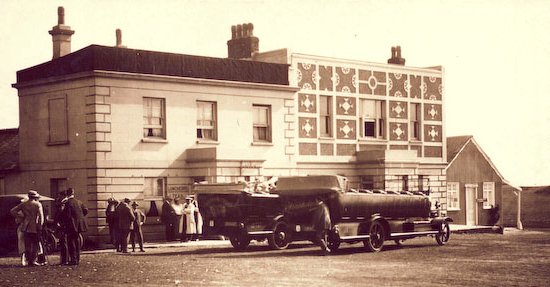
Charabancs outside the Dyke Hotel
I was born at the Devil’s Dyke hotel on 26th June 1923 and, although my father was the hotel manager, it was a strict rule that, as children, we were never allowed in to the hotel. However, when there was noone about we would sneak in, just to see what was going on.
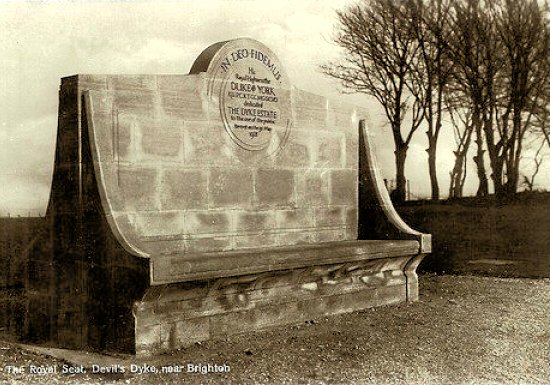
At the time, the hotel was regarded as a grand place, although it was lit with oil lamps and as children we had to take one of these or a candle to light our way to bed – something we found quite scary! There was a public bar, a saloon bar, a smoking room, a ladies room and my mother ran a tearoom at the western end of the hotel. It was very popular and people arrived in charabancs (forerunners of today’s coaches). These were quite a sight: they had solid tyres, every row of seats had its own door, the roof could be opened by the driver turning a handle (an exercise that took some five minutes to complete) and they had carbide headlamps. One event I remember well was a visit by the Duke of York [later King George VI] who, to mark his visit, ceremoniously unveiled a seat at the top of the steep, north slope of Devil’s Dyke.
The Royal Seat
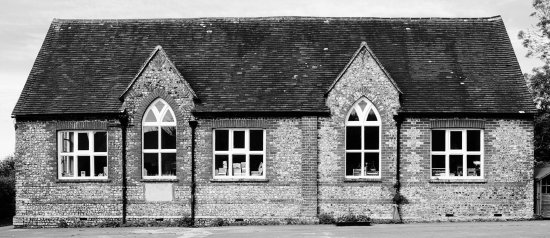
At the age of five, I started to attend school. The nearest school was at Poynings and my sister Irene was already a pupil there and so she was very happy to take me along with her.
There were three different ways to Poynings school from the Dyke and we nicknamed them Bridle, Chalky, and Grassy. Bridle path was a very gentle descent around the south side of the hotel. The Chalky and Grassy paths went down from the north side and when it was wet they were very slippery. It took us about half an hour to make our way to the foot of the Downs and then walk through Poynings village to the school. After school, the climb back up the hill took three quarters of an hour and was far more difficult (as you can imagine) and in winter it was dark by the time we got home. A few years later when my brother Vernon turned five there were three of us making the trip.
Poynings School
The hotel was situated on its own, at the top of the Downs and there were no other children to play with so we had to think of things to do. Father made us a sledge and sure enough, on dry days, it slid down the steep sides of the Downs very well, but not as fast as when the ground was covered with snow. Nevertheless, it was sufficient for us and by repeatedly using the same track it gradually became faster. Father also made kites for us. These were not very sophisticated (unlike modern ones), but by carefully assembling squares of lightweight cloth to crossed sticks (diagonally from corner to corner) and attaching tails to stabilise them, they flew very well in the wind that always seemed to be blowing along the top of the Downs. Otherwise, we had bats and balls and with a few stumps in the ground made out that we were playing cricket and the old favourite game of ‘hide and seek’ was always a popular pastime. Looking back they were very happy days. We always found something to do, never upset each other and were a very happy family.
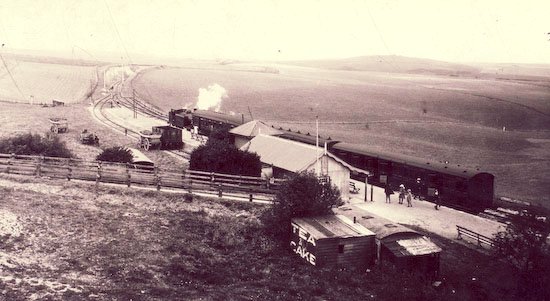
The Dyke Station
Saturday was always shopping day. We would walk to the Dyke Railway Station at about 8.30am — which was much easier than walking to school and more exciting. Mother’s return fare was eight pence and a return ticket for each child was four pence. The journey to Brighton took thirty minutes and as we got nearer to Brighton it became more exciting as we had each been promised a toy of some description. I wasn’t Mother’s pet but she knew that I wanted an aeroplane, that Irene wanted a doll, and that Vernon was happy to take ‘pot luck’.
My father was very strict, being a retired Army man who had served years in India, but we were a very happy family. I feel we were very fortunate to have lived at the hotel, with the fresh air and sunshine in summer and the snow in the winter.
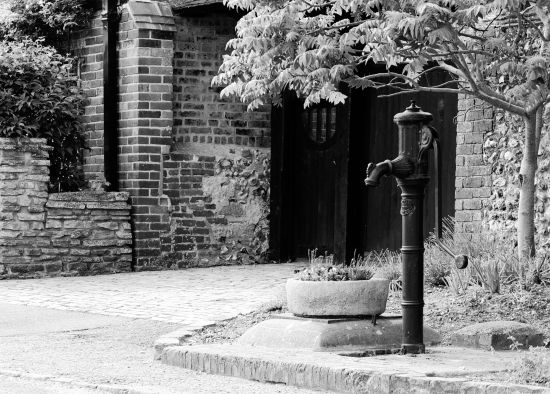
When the Dyke Hotel was taken over by another brewery (I cannot remember the date this happened), we were obliged to move. My father found Yew Tree Cottage in Fulking, which had no electricity (there was no electricity anywhere in Fulking at the time). There were two hand pumps on The Street and we got our water from the one outside Fulking Farmhouse. The other pump was where the telephone kiosk now is and there was a drinking fountain opposite Laurel House.
The hand pump outside Fulking Farmhouse
We soon settled in and my father then found work at the Royal Oak at Poynings with a Miss Gravette who was the licensee. Once again we walked to Poynings School, but walking along the road was much better than climbing up and down to the top of Devil’s Dyke. I finished school at 14 years of age and started work in the local store and post office in Fulking for Mr. Percy Lucas. My duties included serving in the shop, delivering bread and collecting orders from the houses and I continued doing this until I joined the RAF.
War broke out in 1939 and my father rejoined the army almost immediately. I volunteered for the RAF at the age of 17, my sister joined the Army Training Services (ATS) and later, my brother Vernon was called up for the navy. Meanwhile, mother was then living at home with the newest and youngest member of the family — Gordon, who was born in Fulking.
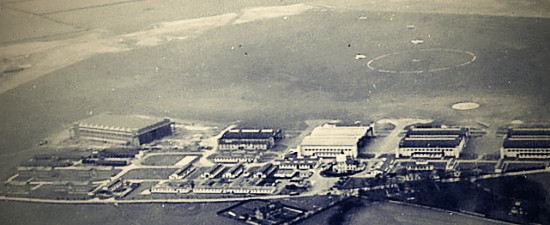
An aerial view of RAF Bircham Newton in 1938
Eventually, I received my call up papers and a rail pass to Manchester, where I did my square-bashing. My first posting was to Blackpool to complete a Wireless Operator’s course and having finished that, I was posted to Bircham Newton in Norfolk. Three months later I was sent to Iceland and was based there for two years, returning in March 1944. In August 1944 I was sent to France and stayed there till the end of the war.
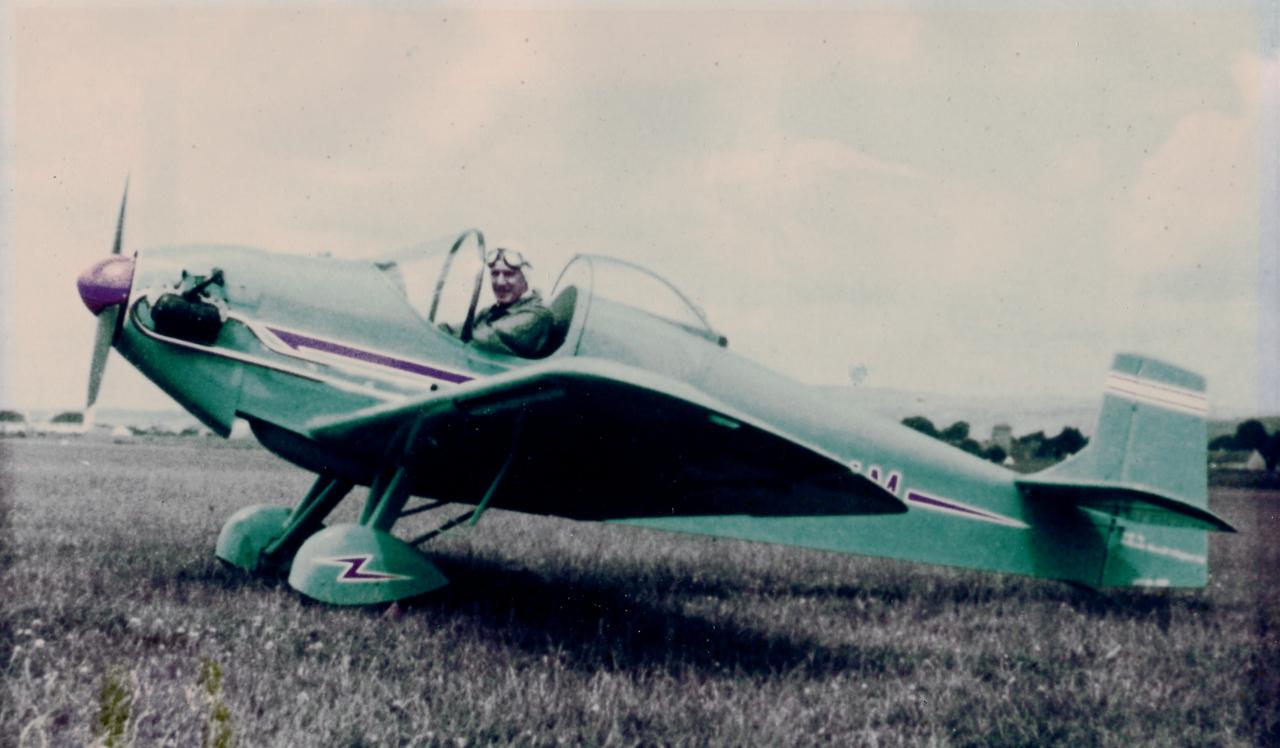
Following my discharge from the RAF, I returned to France as a representative for British Petroleum (BP) and there I married a French girl I had met during my war service there. I was given a privileged residence Identity Card and stayed there for a few years. Later I obtained my pilots license and purchased my own plane, a Druine Turbulent, single seater, with a top speed of 85 knots. For some 26 years, I flew this regularly between France and a small private airstrip at Golden Cross in East Sussex.
Ken Browne at the controls of his Druine Turbulent
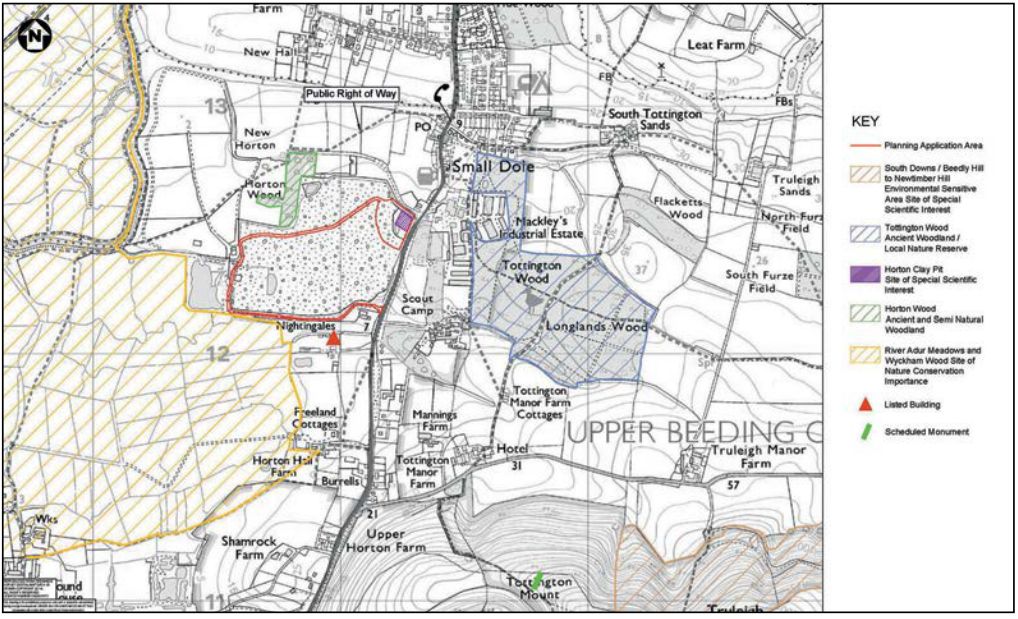
Viridor intends to submit a planning application in June 2014, accompanied by an Environmental Statement, relating to the infill and restoration of the Site of Special Scientific Interest (SSSI) area at the Horton Clay Pit.
In 1991, the former clay pit was granted planning consent for restoration using landfilling. A condition of this consent was that the SSSI would be retained and as a result the landfill was designed around it. The SSSI now forms one side of a shallow excavation with the landfill lying on the other side.
A recent technical stability report found that long-term remediation of the SSSI was not feasible. The only practical and sustainable solution is burial by
inert infill and restoration of the whole SSSI void to prevent any further erosion. Natural England has agreed in principle, subject to the Gault clay being protected by a marker layer.
The scheme will establish additional grassland married into the existing adjacent restoration profile. It will also provide further woodland planting and establishment to enable habitat linkages across the restored landfill.
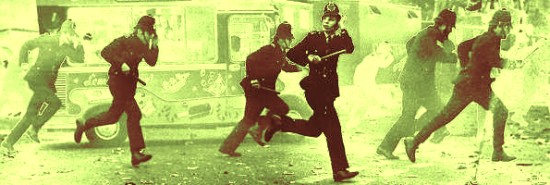
An illegal rave in a National Park was still going strong after nearly 24 hours after police admitted there were not enough officers to close it down.
Officers struggled to control the crowds and eventually gave up, leaving residents to endure the pounding music.
One resident in nearby Poynings, who did not wish to be named, said last night: “It’s really loud and it’s been going on all night and all day. .. I can see why it might be difficult to move them off the hill but I can’t understand why there aren’t more police officers to get rid of them.”
A [police] spokesman said: “At present the assessment is that it would not be possible or safe to close the event down, given the number of police officers available. “
“I spoke to one police officer nearby and asked them what they were going to do about it and I was told ‘we only have four officers, so there’s nothing we can do’.”
The rave, which is still going strong more than 24 hours after it started, shows no sign of stopping and party-goers have warned it could ‘carry on for days’.
A [police] spokesman said: ‘Overnight it was assessed that due to the darkness, rain, and numbers present, it was not appropriate or practical to attempt to close the gathering safely. With daylight, officers have been re-assuring local residents that action is being taken .. At present the assessment is that it would not be possible or safe to close the event down, given the number of police officers available.’
Poynings residents express their views in an Arguscomment forum:
7:21pm Sun 25 May 14 binbag says
It’s still going on now. No sleep again tonight. Don’t think the police stopped people going up there early enough. As the police are taking no action won’t this just encourage this happening more often.”
7:25pm Sun 25 May 14 Josie81 says
It’s a bloody nightmare here in Poynings. No sleep last night, can’t work today (I am studying for exams), and tonight seems set to be just as bad as last night. Police don’t seem interested in doing anything about it. Probably all down at the beach …
7:35pm Sun 25 May 14 binbag says
I’m in Poynings too. Was so loud last night. Doesn’t seem as loud now but that could be just the way the winds blowing. Too exhausted to do anything today. Hate to be a killjoy but hope it pours with rain tonight!
7:40pm Sun 25 May 14 Josie81 says
Yes, BB, nature looks set to take revenge with lots of lovely rain tomorrow 🙂 What a horrible mess these ravers have made of our beautiful Downs. Feel very sorry for the poor animals trying to rear their young in peace.
Senior officers .. blamed rain and darkness for their decision to let the 2,000-strong party go on for more than 24 hours. .. Temporary Chief Constable Giles York .. said “It was dark, it had been raining on and off and footing was unsecure. [Raves] are not safe places. .. It’s not as simple as walking in and taking the power lead out.”
Chris Gildersleeve and Jen Green are showing their art in Ditchling as part of the Brighton Open Houses scheme over the Bank Holiday on 26th May, from 11:00am to 5:00pm, at Kennel Cottage, 88 East End Lane, Ditchling BN6 8UR. Chris is showing fired sculpture of human figures, natural forms and Buddhist themes, and Jen is showing landscapes in watercolour, prints, woodcarvings, mosaic mirrors and cards.
[Corrected.]
Cantatrice will perform on Friday, May 30th, at the Steyning Centre, 12:15pm–1:00pm, while Kaleidoscope Singers perform on Thursday, June 5th, at Christ the King Catholic Church, Penlands, Steyning, 8:00pm–9:00pm. The evening concert will feature madrigals, sacred music and Stephen Foster arrangements, and includes a string ensemble and Hannah Corcoran on saxophone. More details here.
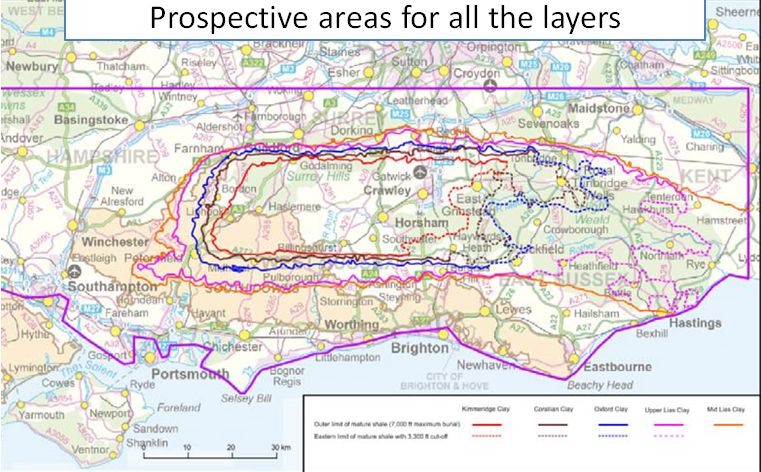
Today’s papers are full of shale! shock!! horror!!! in the wake of the new British Geological Survey report on oil and gas in the Weald Basin. Contrary to the impression given by the Telegraph, for example, the intersection between the South Downs National Park and the area thought likely to contain hydrocarbons is actually quite small. Fulking is well outside the core hydrocarbon area. If you want to learn more then read the report itself, not the reports of the report.