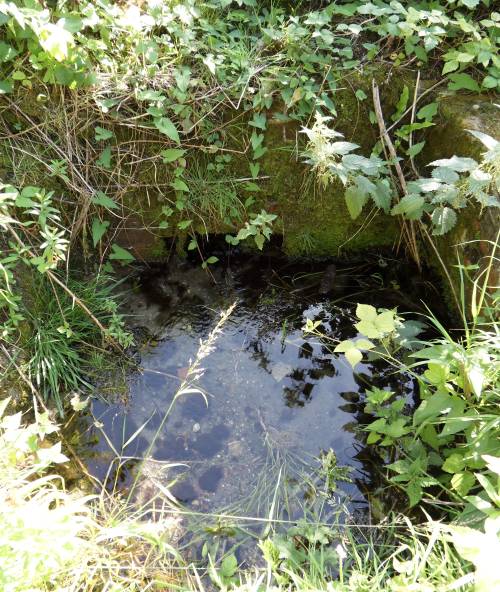
Lady Brook Spring as it was before the recent work
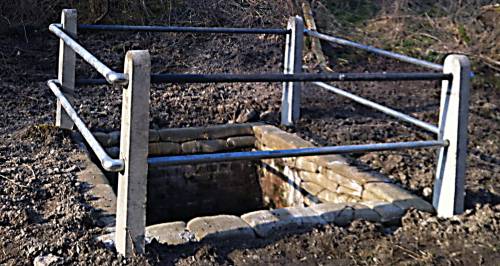
The recent work carried out at the Lady Brook Spring, just west of the main stream at the Shepherd and Dog, was a complete surprise to the Parish Council.
The PC has recently been in discussions with WSCC Highways about a very different proposal, possibly involving flint work and sympathetic planting along with measures to ensure that safety is improved to reduce the risk of drowning by children and animals. The very stark (some may say hideous) structure that has been built addresses neither safety nor aesthetics – indeed, the new railings (being very open) have vastly increased the risks, as well as being totally out of keeping with the surroundings.
The PC has contacted the Highways department with an urgent request to rectify the situation; we will publish any information on this as soon as we can.
If anybody has any suggestions or thoughts as to how we could make this a special feature of our village, please contact Andrea Dickson – andreadicksonfpc@gmail.com.
Fulking Parish Council
Fulking Village hall has been awarded £1000 by the BT Awards scheme thanks to Ceri Thayer a member of the Village Hall Action Group.
BT People Awards reward local community groups, charities and organisations where BT people volunteer their time. Our Village Hall is one of hundreds of groups who applied for an award during this round of the scheme and impressed judges with how they would use their grant to make a difference to their group and benefit the local community. The BT People Awards provide a great opportunity for community groups like ours to get some additional help that can make a huge difference.
It is very positive that BT recognises the voluntary work of its people in this way. The Village Hall is going from strength to strength with community events and the VHAG are very grateful for this donation.
In a Pigeon-less world (not for much longer, soz), what we need is a bit of variety theatre, right?
Which is why FULKING’s GOT TALENT comes round again at breakneck speed. Next Friday 5th April, to be exact. Come and support the amazing array of musical, theatrical, athletic and general all-round awesomeness of our Village Young. It’s been a blast these last two years and 2013 will be no exception. Listen, have fun, enjoy… and then stay for a cheerful beverage or three.
DATE Fri 5th April
TIME 7.30pm
PLACE Village Hall.
My grandfather, Henry Harris, came from a farming family that had farmed in Dorset for about two hundred years. In 1891 he moved to Silton Manor, a farm of about 400 acres near Gillingham in Dorset. His son, my father, was also called Henry. Dad was one of a family of seven boys and six girls. The boys all became farmers and the girls, with one exception, married farmers. Five of Henry’s brothers fought in the 1914-18 war. They were all in the Dorset Yeomanry, as most farmers’ sons were and all returned without serious injury. My father was in Egypt and Palestine fighting the Turks and apart from being stung by a scorpion and a few bouts of dysentery was unscathed. In 1991 a centenary gathering was held at Silton Manor and about sixty relatives and other folk connected with the Harris family attended. Some came from as far afield as New Zealand and one from Zimbabwe. Two coaches were hired to take the guests on a tour of the Dorset farms where members of the family had once been tenants.
Over time the family had been able to purchase the farm and the size of the holding had been greatly increased. Six of the seven sons gradually left Silton once they had saved enough money to branch out on their own, leaving the youngest brother as tenant at Silton, until, at a later date, he was able to buy out his brothers. My father (Henry) married my mother Amy in 1920 and left the family farm in Dorset in the same year. At first Amy stayed behind while Henry moved to Sussex and rented a large farm of about 800 acres in Fulking called Perching Manor. This was in Crown ownership and later more land, adjoining the farm, belonging to Brighton Corporation, was rented. The land associated with these farms had become very run down and it took several years to return the land to good health. Amy came out to join her husband in 1922.
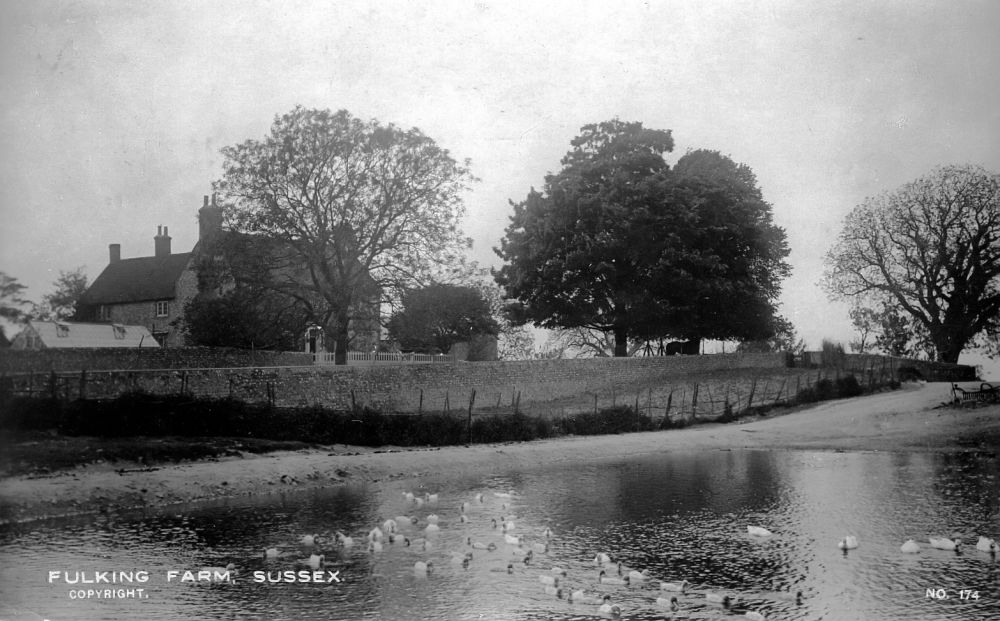
Perching Manor as it was between the wars
At that time there were no tractors and all the cultivation was done using heavy horses of which there were about ten at Perching. The carters started start work at five o’clock in the morning and stopped at half past three in the afternoon. It took two horses and one carter with a single furrow plough, to plough one acre a day. At the end of the day they then brought the horses back to the stables, fed them and bedded them down for the night.
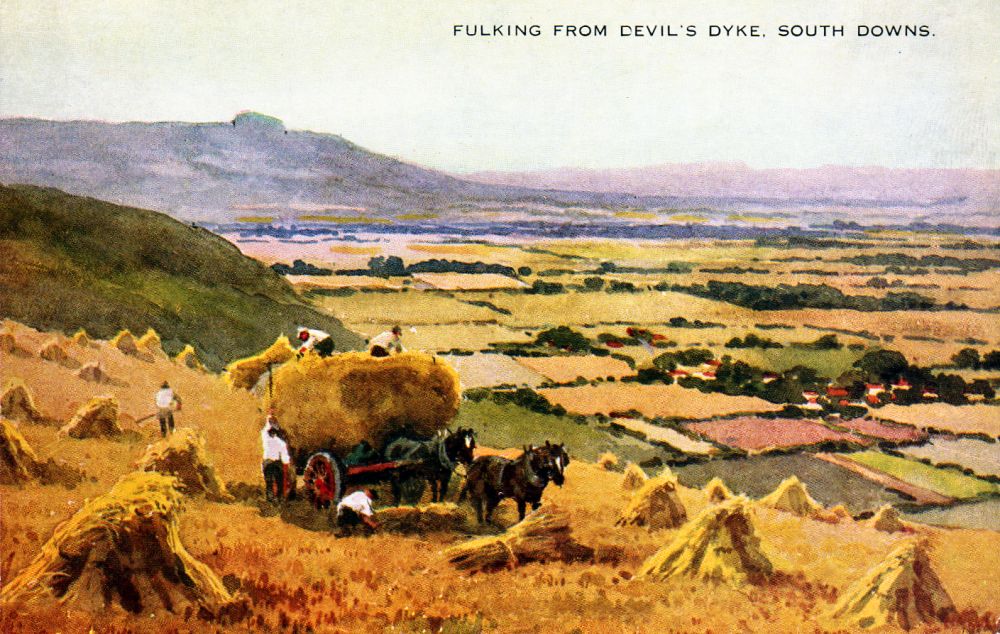
Harvesting on the Downs above Fulking
It was not long before Henry and Amy’s family had grown considerably. Their eldest child Henry, was born in 1926, Brian came along in 1927 and Geoffrey in 1929. They were followed by Susan in 1932, Edwin in 1936 and Alban in 1940. All the boys except Henry worked at Perching Manor Farm and Susan married a farmer.
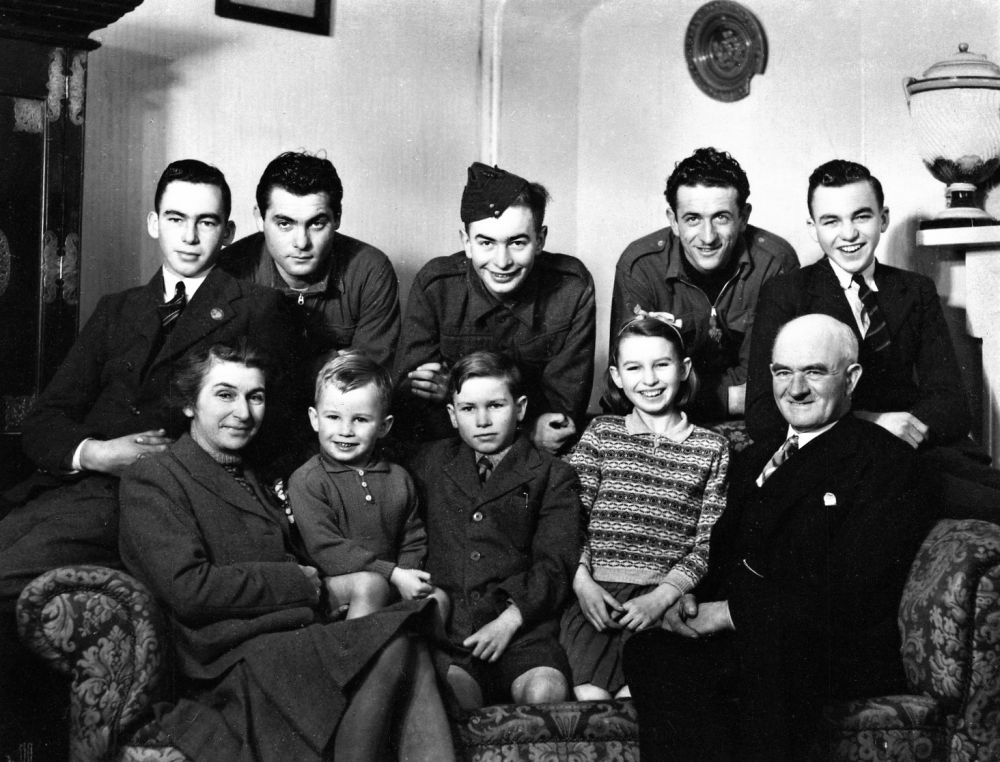
The Harris household in 1943. Front: Amy, Alban, Edwin, Susan, Henry. Behind: Brian, Adolfo Marine [POW], Henry, Carlo Mazon [POW], Geoffrey.
Henry won various scholarships first to Oxford and then to American Institutions. He later became a professor aged 23. He took out American citizenship and spent the rest of his working life teaching classics in the USA and Canada. He retired to Vancouver Island in British Columbia and died in March 2007.
A large part of the farm was on top of the Downs where there were cottages for the farm labourers and stabling for the horses. A large flock of sheep was maintained and the land was kept fertile by folding them over land that was used for growing turnips, swedes and various brassica crops.
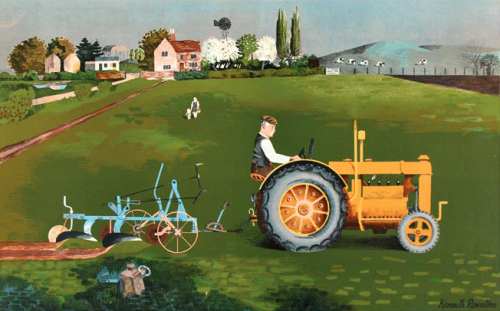
A Fordson tractor pulling a two-furrow plough Kenneth Rowntree, 1946
Henry Harris was a good farmer and soon gained respect among the farming fraternity. In the early years, it was a mixed farm with a large dairy herd, a flock of sheep and a large arable acreage. In 1937/8 Henry bought their first tractor: a Fordson. From then on cultivation became easier. The tractor could pull a two-furrow plough and this meant that three acres a day could be ploughed.
When war was declared in 1939, farmers were pressed into increasing productivity. Perching became much more mechanised and the acreage put to the plough was increased. A greater variety of crops was grown, including flax, potatoes and other vegetables. Any land worked by hobby farmers that was considered unproductive was confiscated and handed to more efficient farmers for the duration of war. My father’s acreage was considerably increased by the scheme.
Bren Gun Carrier
In 1941 all of our land on top of the South Downs was requisitioned by the War Department for training the army in the use of live ammunition. This left us with only the north escarpment of the Downs for grazing and a fence was erected along the top of the Downs to keep our cattle off the artillery ranges. However, there was plenty of grazing on the ranges and the temptation was to leave the gate open and let the cattle get to the better pasture. It was during this time, whilst out on my horse looking for our quite large herd of cattle, that I came across a Bren Gun Carrier with some men from the electricity board mending wires that had been brought down by artillery fire. I enquired if they had seen our cattle and they directed me to an area where eight steers and heifers lay dead. Apparently a mortar bomb had landed right in the middle of them and this was the result. It was debatable who had left the gate open, but we claimed the Army was at fault and we were compensated £18 a head for each animal.
In 1942 three Italian POWs came and worked on the farm. They were billeted in the cellar at Perching Manor, which was a great help, as most of our young labourers had been called up. The Italians weren’t repatriated until 1947 and in the meantime we also acquired two German POWs who returned home in 1948. Before the Germans left we were allocated two Latvian displaced persons. One left for Canada after about 3 years, the other, Rudolf, remained at Perching for his entire working life.
“Looking back, it was a rather a ‘Heath Robinson’ affair.”
In 1947 we purchased our first combine harvester. A Minneapolis Moline, which made an 8ft (2.4m) cut and was not selfpropelled. Looking back, it was a rather a ‘Heath Robinson’ affair. But at that time it transformed harvesting. The farm had by now become highly mechanised with several caterpillar tractors and other modern equipment and in 1948 two more combine harvesters were purchased.
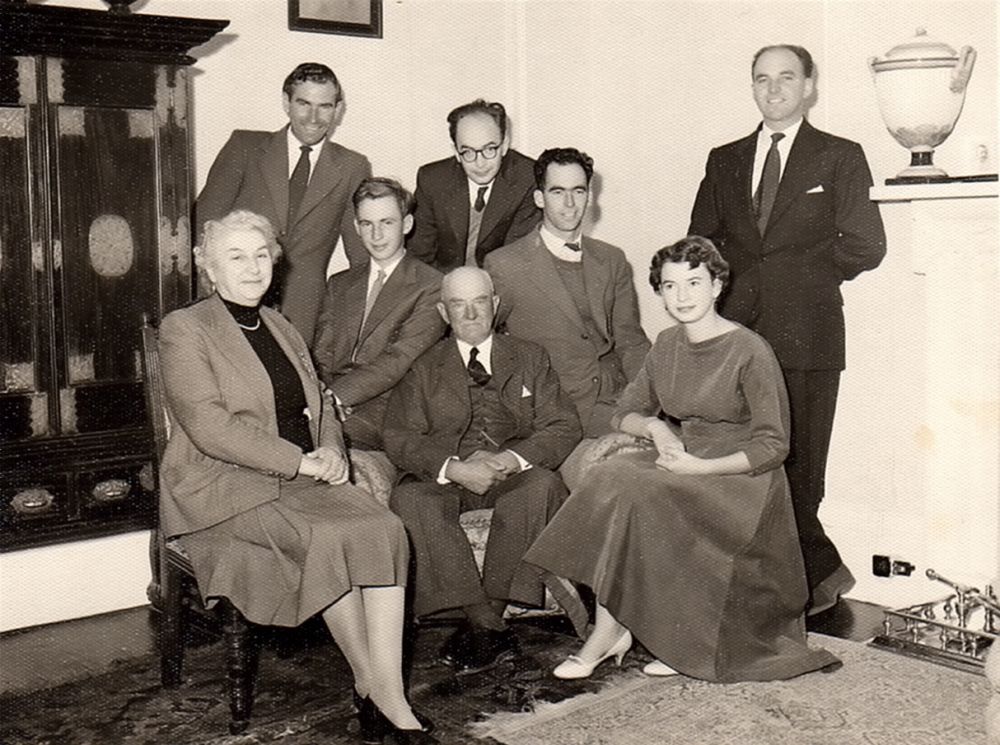
The Harris family in the late 1950s. Seated at front: Amy, Henry, Susan. Seated behind: Alban, Brian. Standing at rear: Edwin, Henry, Geoffrey.
In 1950 my father formed a partnership between himself and four of his sons (Brian, Geoffrey, Edwin and Alban). The farm was considerably enlarged in the 1950s with the largest addition being a 250 acre farm purchased at Findon, along with another of 160 acres at Small Dole. By 1960 the Harris holding was in excess of 2000 acres, about half of which was owned by the family and the other half rented.
By this time our milking herd was long gone. It had to be disposed of because it had become too difficult to get staff willing to start very early in the morning and work a seven day week. Perching became an arable, sheep and beef farm, growing about 1000 acres of grain, mainly barley, and maintaining a flock of 1000 breeding sheep and a herd of 250 beef suckler cows. Most of the animals were fattened and then sold on.
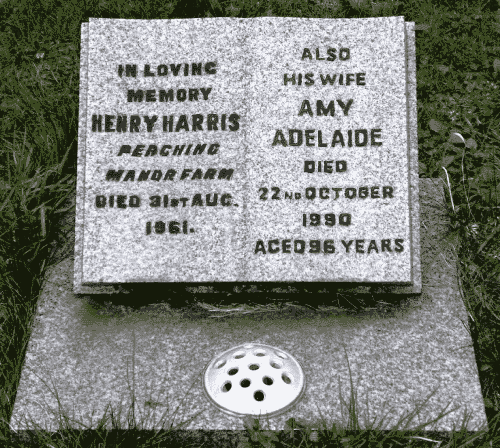
Henry Harris died in 1961 aged 72 and his wife Amy in 1990 aged 96. Amy had lived at Perching Manor for sixty years.
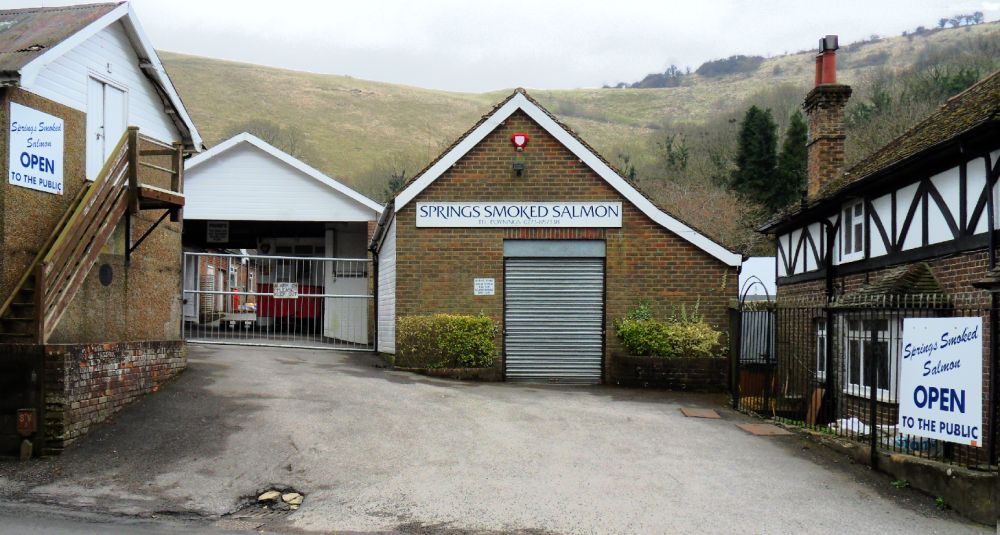
Springs Smoked Salmon in Edburton
Geoffrey left the partnership in 1964 and bought the Findon Farm from the business. He and his wife Josephine started Springs Smoked Salmon in the same year and in 1972 they sold the farm and concentrated on the salmon smoking business, which is still carried on by their two youngest sons.
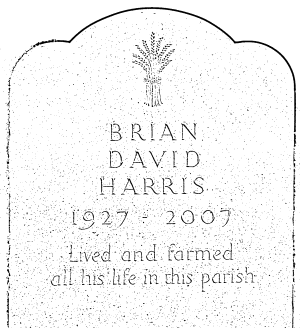
Brian took over running Perching Manor Farm, as his brothers gradually branched out to run their own farms. Edwin went into sheep farming and is now retired. Alban (Shiner) has land at Pyecombe and Fulking and rears beef cattle.
The administration of the English National Concessionary Travel Scheme in West Sussex is changing from 1st April 2013.
If you already have an older or disabled persons’ concessionary bus pass you do not need to take any action. Your current bus pass will continue to be valid and will be renewed automatically.
After 1st April, if you are applying for a new bus pass, or if have any queries about your current pass, then please use the following contact details:
Bus Pass Information Line (local rate): 0845 075 1018
West Sussex Bus Pass, PO Box 212, Waterlooville PO7 6ZN
Could you provide a warm and loving home for some of the most vulnerable children in West Sussex? Could you become a foster carer?
Foster Care Fortnight, the annual campaign run by the Fostering Network to highlight the need for more foster carers, takes place this year from Monday 13 to Sunday 26 May.
West Sussex County Council runs monthly fostering drop-in sessions across the county, which are an ideal chance for anyone interested in finding out more about fostering to come along to.
You can speak to officers from the fostering team, and some drop-in sessions have foster carers present so you can speak to them directly and find out more about what being a foster carer is like.
Foster homes offer children a stable family environment while their own parents are unable to look after them. Could you help in providing this vital role?
There are many reasons why a child comes into foster care. Their stay with foster carers could be short-term until they can return to their parents, or it might need to be longer term.
The County Council tries to place children with foster carers in their local area, so they can continue to stay close to their school, friends, people and places they know. This means the Council is always on the lookout for new foster carers to come forward from across West Sussex.
Foster carers come from all walks of life and from a range of cultural and ethnic backgrounds. People from a variety of backgrounds can apply to foster, regardless of their marital status or sexuality.
What is important is skills such as a good sense of humour, patience, energy and the ability to treat children and young people as individuals.
Foster carers receive a comprehensive support package from the County Council, including on-going training and financial allowances to meet the needs of the children in their care.
Are you interested and would you like to find out more? You can visit the website at www.westsussex.gov.uk/fostering for further information and details of all the drop-in sessions, or call 01403 229333.
Fostering drop-in sessions run from 10am to 4pm. The sessions taking place in West Sussex in 2013 are:
Saturday 18 May, Worthing Library, Richmond Road, Worthing, BN11 1HD.
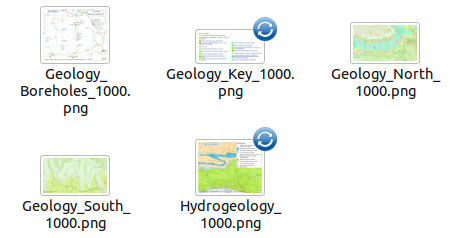
A page displaying a small set of maps describing the local geology has been added to the About Our Village menu in the left sidebar. Of necessity, the maps are large image files so attempting to look at them via a mobile phone is probably not sensible.

 Aidan writes:-